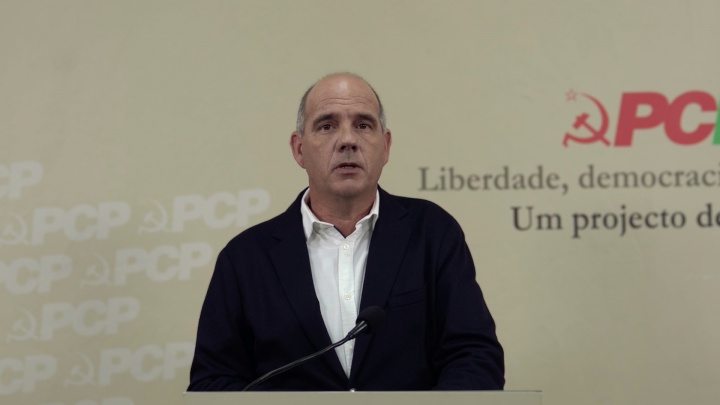
The great and expressive scale of today’s General Strike is an enormous statement of the workers’ strength and unity, and a powerful expression of rejection of a labour package [of laws] at the service of capital, which was put forth by the PSD/CDS Government and which is supported by Chega and Inicativa Liberal [parties].
The sole purposes of the labour package are to worsen the already unsustainable prevalence of low wages; to make precarious jobs the norm; to even further deregulate working hours, fomenting unpaid work and making workers’ lives hell; to reduce the rights of mothers and fathers, which are at the root of the rights of children; to weaken collective bargaining; to call into question the right to trade union meetings, action and information; to restrict the right to strike, which is a decisive weapon in defending the workers’ rights and dignity and in improving their living standards.
The General Strike expresses the workers’ strength and unity. They have made their voice heard, and expressed their indignation and protest against the model of exploitation and injustice to which they are subjected, against low wages, precariousness, the deregulation of working hours, against unbearable conditions and rates of work, against the disrespect for their rights.
Today’s General Strike is a historic day of demand for justice, dignity, respect, better wages and more rights.
Confronted with the mounting profits of the big economic groups and multinationals; with a policy of plunder of wages and of public resources; and with social regression and favours for big capital, the General Strike raised the voice of those who produce, who create the wealth, who ensure that the Country operates and can move ahead.
This day is even more significant taking into account the entire arsenal of expedients, of pressure and blackmail, including the abuse of so-called minimal services, which attempted to jeopardize the right to strike and to conceal its effects.
The overall failure of this operation, which also included spreading disinformation, demagoguery and lies, highlights even further and gives more value to the scale of participation in the strike.
The General Strike places labour and the workers’ conditions at the core of public debate. It is a strong warning to the big bosses and the Government that they must withdraw, not just one or other aspect, but the entire labour package.
Only in this way will it be possible to eliminate the anti-social and anti-democratic nature which characterizes it, with its enhancement of exploitation and violation of human rights.
The General Strike is a vivid assertion of democratic freedoms and rights, which shows that the workers and the people, using all the rights that are enshrined in the Constitution of the Portuguese Republic, are strong enough to resist and confront social regression and anti-democratic revanchism, but also to open the path of social progress which Portugal needs.
The General Strike was one of the biggest ever, with a major participation by the workers, many of whom for the first time. It had a significant impact throughout the whole country. In it took part workers with permanent and with precarious contracts; immigrant workers; a prominent participation of young people and women, a strong expression in the main sectors of activity, in industry and services, of both the private and the public sector.
In industry, a large number of companies stopped, such as Autoeuropa and its industrial park, GrozeBerkt, Inapal Metal, Hutchinson, Preh, Exide, CelCat, Euroresinas, Gallo Vidro, Bosch, Apptiv, ITA, Somelos, Ecco, Tescap, Forvia, Aumovio Antenna, Browning, Cofisa, Superbock, Coca Cola, Cereauto, Valorsul, Visteon, the Panasqueira Mines.
In fisheries, the fish markets and fishing fleets came to a halt.
In transports, there was the full stoppage of the Lisbon Underground, CP [rail services], IP [rail and road infrastructures], Transtejo/Soflusa [Lisbon boats], STCP [Oporto bus company], urban transports namely in Braga, Coimbra and Barreiro; and strong participation in the Oporto Underground, Carris [Lisbon bus company], in private passanger road transports, with the exception of the [legally-imposed] minimum services. The country’s ports came to a halt. In the airline sector, there was an almost total participation, with only a few minimal services operating.
In the Public Administration there was a strong participation in the health sector (hospitals and health centres); in education, with most schools closed and an important participation in higher education; in social security services; in the judicial system; in tax offices; in museums and other services, with a prominent participation in Local Government, in many areas, namely refuse collection.
In the service sector, with prominence in areas such as logistics, large-scale commercial retail, hotels and canteens, the finance sector, social support structures such as IPSS and Misericórdias.
The strike had strong participation in other sectors such as postal services, telecommunications, energy, culture, the arts and show-business and the mass media.
The strength of this General Strike is also expressed in the streets, with thousands of people taking part in the many hundreds of strike pickets and in dozens of rallies and demonstrations. These contributed to the success of the general strike and to assert the demands for more rights and a better future.
The PCP hails the workers for their participation in the General Strike against the labour package, against regressions and exploitation, and in demanding better wages, more rights and public services.
PCP hails CGTP-IN, the Portuguese workers’ great trade union central, which took the initiative of moving ahead with the actions against the Labour Package and with the General Strike that was announced during the national demonstration of November 8th.
PCP hails the trade union structures and other workers’ organizations who took a stand and joined the Strike, the thousands of trade union leaders, shop stewards, members of Workers’ Councils, and all workers who took an active part in raising awareness, in the mobilizing and organizing which was decisive for the success of this great day of struggle.
The path towards a just, developed and sovereign Portugal implies that it is necessary to continue the struggle to reject the labour package, to value labour and the workers, to fulfil the Constitution of the Republic and materialize the rights which it enshrines.
The Country needs a different course and a different policy. A policy where the rights of working people are a requirement and a goal for development.
The path that is needed is one that increases wages, that fights against precariousness, that values collective bargaining, that defends and strengthens public services, that ensures the right to housing, that promotes national production and public investments.
This path is in the hands of the workers, of the people and of the youth, with the immense strength that was on display today.
Strength, courage and unity can open this path of hope and for a better future to which they are entitled.
In this struggle you will always count, as you have always counted, with the PCP.